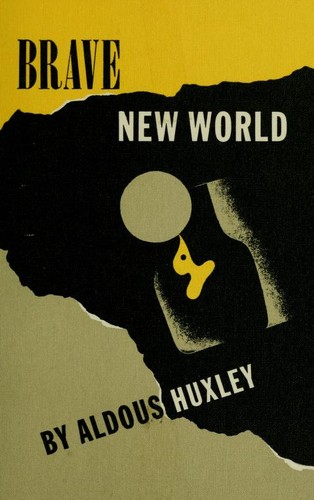
I read this in high school back to back with 1984, the way half of us apparently did, and remembered it as the friendlier dystopia, the one where everyone’s medicated into contentment instead of tortured into submission. Coming back to it now, older, I noticed things a sixteen year old me clearly skated right past, how casually the book sorts its lowest caste into short, simple, and happy to push a broom, how the Alpha caste maps uncomfortably close to the eugenic ideal that was very much in the air when Huxley wrote this. That stuff clangs now in a way it didn’t the first time, and I don’t think noticing it ruins the book, but it changes what kind of book I think I’m reading.
The premise still holds up mechanically, better than I remembered honestly, test tube gestation, conditioning that makes people happy with jobs a person would otherwise resent, promiscuity as a civic virtue instead of a private choice, soma as the pill that keeps the whole machine content. John the Savage, raised on a reservation with nothing but a battered volume of Shakespeare for company, gets dropped into this world and becomes first a novelty and then a national joke, and his arc toward the ending is genuinely bleak in a way the “happy dystopia” label undersells.
What struck me hardest on this pass is how the book’s own prejudices, patriarchal, casually racist by any modern read, sit right alongside a warning that still mostly works. Huxley was a man of his moment writing about a future he feared, and both of those things are visible on the page at once. I don’t think that disqualifies the book, but it does mean I’d hand it to someone now with a heads up rather than without one.
Four stars. Still sharp after ninety plus years, just sharper in different places than I remembered.